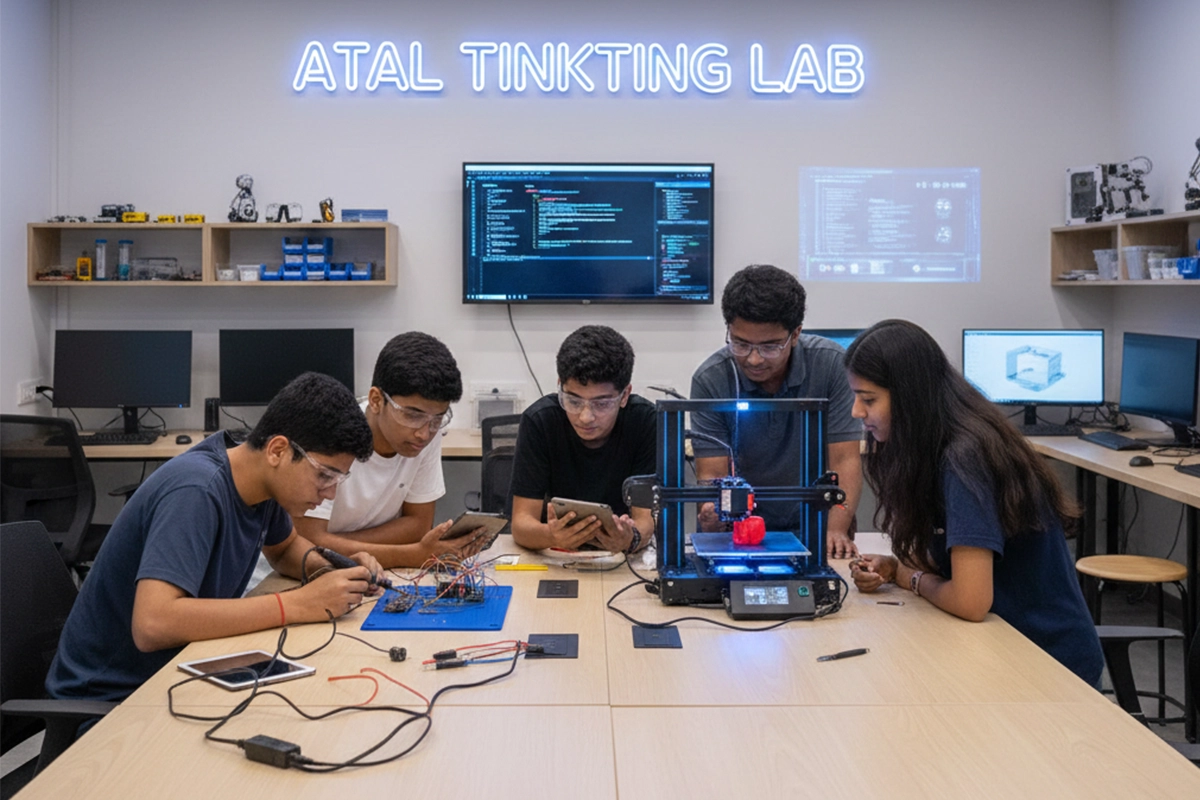
The Indian educational framework is entering a new era of transformation. We are moving away from rote memorization toward a culture of innovation, creativity, and “tinkering.” At the forefront of this revolution is the Atal Innovation Mission (AIM) by NITI Aayog, an initiative designed to foster curiosity and imagination in young minds through Atal Tinkering Labs (ATLs).
For a school principal or administrator or owner, securing an ATL grant is a very prestigious achievement. But, the journey of receiving the grant letter to Lab inauguration day can be daunting. How do you translate funding into a fully functional innovation hub? This blog will help you know exactly what all is required.
This guide breaks down the essential steps to setting up a successful ATL and how a partner like Abhilasha Commercial can turn this complex process into a seamless turnkey solution.
- Defining the Space (The “Where”) An ATL is not just another classroom; it’s an innovation playground. NITI Aayog guidelines recommend a minimum built-up area of 1,500 sq. ft. This space needs to be flexible. Forget rigid rows of desks. You need modular furniture that can be rearranged for group projects, ample storage for sensitive electronics, dedicated power points for workstations, and, crucially, inspiring aesthetics that signal to students: “This is a place to break things and rebuild them better.”
- The Procurement Puzzle (The “What”) This is where most schools face their biggest hurdle. The AIM guidelines mandate four specific “packages” of equipment:
- Package 1: Electronics Development & Robotics: The heart of the lab, featuring Arduino/Raspberry Pi kits, sensors, and motors.
- Package 2: Rapid Prototyping Tools: Including 3D printers and filament to turn digital designs into physical objects.
- Package 3: Mechanical, Electrical, and Measurement Tools: The essential hardware like soldering stations, drilling machines, and multimeters.
- Package 4: Power Supply & Accessories & Safety Equipment: Ensuring a safe and stable working environment.
Sourcing these hundreds of individual components from different vendors, ensuring they meet NITI Aayog specifications, and handling warranties can be an administrative nightmare. This is where Abhilasha Commercial steps in. We provide pre-configured, fully compliant ATL bundles that cover all four packages. We ensure every sensor, wire, and 3D printer meets the exact standards required by the government, saving you months of procurement headaches.
- Beyond the Boxes: Training the Trainers (The “How”) The most sophisticated equipment is useless without a motivated teacher to guide the students. An ATL set up without pedagogical support often ends up as a locked room filled with dusty equipment.
Successful ATLs rely on empowering the faculty. Your science and math teachers need to transition from “instructors” to “mentors.” At Abhilasha Commercial, we believe installation is just the beginning. Our turnkey ATL solutions include comprehensive teacher training modules, helping your staff understand not just how to operate a 3D printer, but how to integrate it into a physics lesson or a design project.
Conclusion: Your Partner in Innovation Setting up an ATL is an investment in the future of your students and the reputation of your institution. It requires technical expertise, compliance knowledge, and educational vision. By partnering with Abhilasha Commercial, you gain a dedicated ally who manages the entire lifecycle—from site inspection and equipment supply to installation and faculty training—ensuring your ATL becomes a vibrant hub of discovery from day one.